
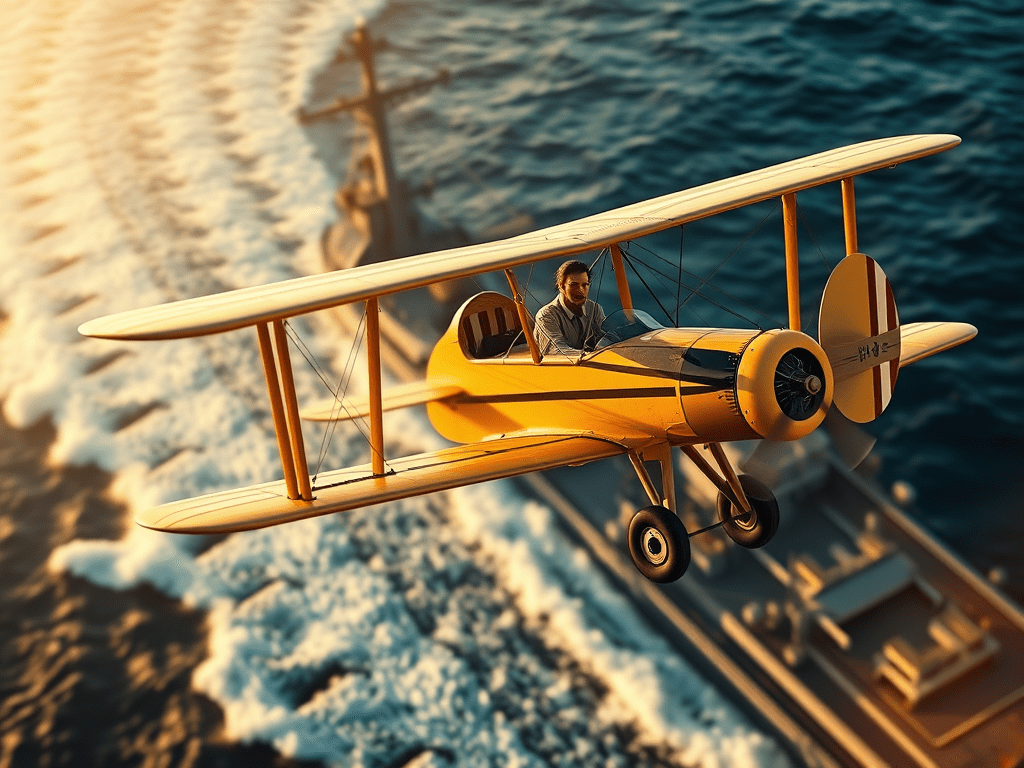
‘May 8th 1911′, a date that will always, forever echo in my mind until it stops sending pulses. Why is that date important? It’s the birth of Naval Aviation, and an essential part of history when a Sailor goes to get his Wings. I earned my wings at 19 years old, I learned them and boarded on 4 separate platforms (meaning I went through 4 murder boards, then 4 actual oral questioning boards.) It was a rough one with lots of studying.
Essentially, if you’re in Naval aviation, this is the pedigree all your work stems from. On May 8th 1911, a purchase request was made by Captain Chambers in San Diego for the Navy’s first aircraft from Glenn Curtiss (who is credited for founding the U.S. aircraft industry. The Navy purchased 3 planes for $25,000, the pilots would be trained by the Wright Brothers and Curtiss near Annapolis.
But this had been in the works for some time before the purchases were made. Eugene Ely had moved his family to Portland, Oregon. He was a motorcycle racer who had traded that life in for selling cars, which he was successful in. Ely met a friend who had purchased one of Curtiss’s biplanes, but didn’t know how to fly it, so he learned to fly it himself in exchange for fixing the plane.
With his success in repairing the plane and learning to fly he got permission to fly from Portland to Minneapolis in June to join in an aircraft expo, where he would meet Curtiss and begin working for him. By July, Ely was in Winnipeg showing off more planes, by October, he had the Aero Club of America’s 17th pilot license.
One month after receiving his license, Ely and Curtiss would meet with Captain Chambers and would lead two experiments; taking off and landing on a vessel. The first happened in November 1910. Ely launched from a temporary platform established on the USS Birmingham in Hampton Roads, VA. The aircraft did drop after launch (an iconic event that still happens today with F/A-18s, though not nearly to the same extent). His wheels touched the water, but he recovered. He was unable to fully complete his mission of circling the water several times and landing in Norfolk shipyard, instead landing on closest land. It was seen as an ultimate success. At the time the only other nation tinkering with the same idea was Italy.
On January 18th 1911, Ely attempted the other experiment. He launched his plane from the Tanforan Racetrack (now adjacent to San Francisco International Airport) and he landed on the USS Pennsylvania, which was ported in San Francisco Bay. This was also the first use of a catapult system, made by Hugh Robinson, a circus performer and aviator.
After these successes, Ely would ask Captain Chambers about employment with the Navy to push aviation fleet wide. While Chambers liked Ely, Naval Aviation Commands (squadrons) were not established or being considered, as Chambers was to determine the feasibility of naval aviation as a warfare tactic. Chambers warnings to Ely continue to echo in aviation to this day. He preached safety and consistency in aviation for the sake of safety and furtherance of the cause of aviation within the military. He understood that if aviation could not be safe as well as lethal, it wouldn’t be adopted. Ely, in truly chiched, pilot thrill seeking behavior, had a knack for dangerous stunts and pushing the limits.
On October 19, 1911, less than half a year into the Navy’s adoption of aircraft, Ely was killed. He was flying in an exhibition show in Macon, Georgia where he was delayed in pulling out of a dive and crashed. While Ely was able to eject by jumping out of the plane before impact, his neck was still broken. Bystanders rushed over to the plane to pick it apart for souvenirs, with people even looking for personal affects of Ely (such as his gloves) while he lie feet away actively dying from a broken neck. He would be posthumously awarded the Distinguished Flying Cross and entered into the National Aviation Hall of Fame.




 Creator1
Leave a reply to Herald Staff Cancel reply