
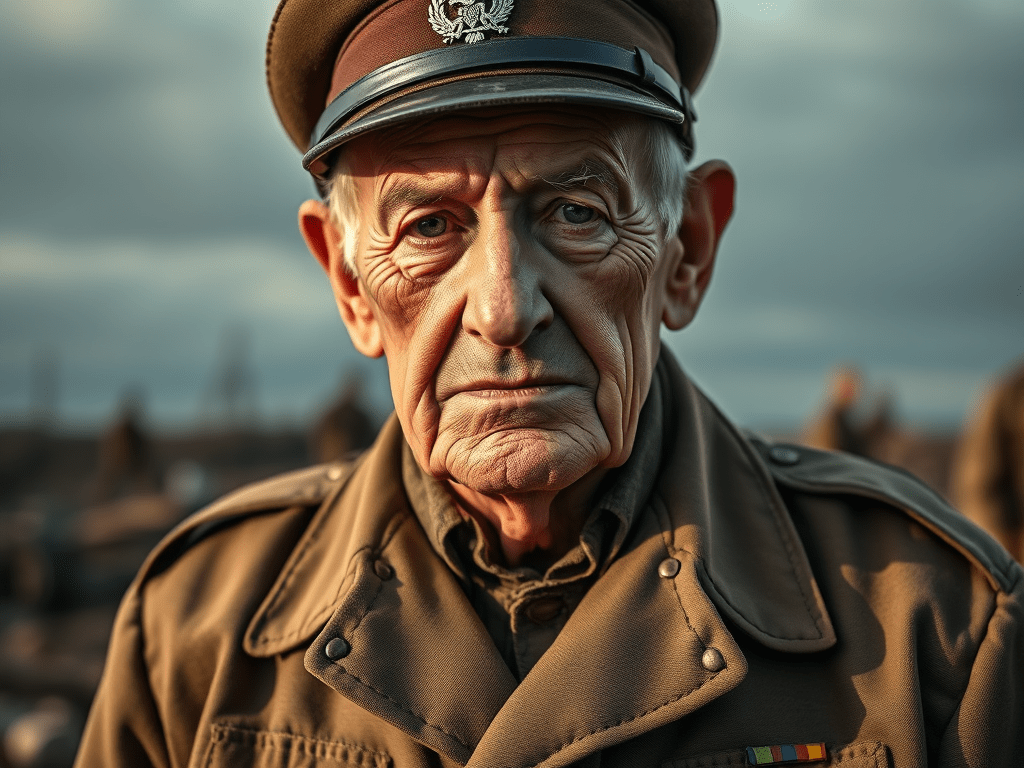
There are often many movies made about World War Two and all the heroic efforts made to defeat the enemy. It’s a moral story, a story painting the Allies as the ‘good guys’. I’m not sure if that would really happen for World War One, the stories and timeline is far too brutal, scary, and depressing to have the makings of a blockbuster movie. Think about it, this was a time when the old world met the new, a time where you had men on horseback charging with swords drawn, only to be obliterated by the advent of machine guns, planes, and mustard gas. Castles that had stood for centuries as bastions to power and wealth, crumbled in minutes of an artillery barrage.
This brings us to the subject of the article, Frank Buckles. Frank would become the oldest surviving American World War One veteran. He passed away on February 27, 2011 at the age of 110.
Buckles joined the Army in 1917 at the age of 16, he lied to his recruiters. After joining, he was attached to 1st Fort Riley Casual Detachment, casual meaning unassigned. He had told the Army that he was a bank teller previously which made his superiors attempt to give him an office job. He refused this job and he was sent to Europe.
He would board the Carpathia, the ship that rescued people from the Titanic incident. Unfortunately, the unit would be diverted from France to stop in Winchester, England to relieve the Sixth Marines at hospital camp 25.
While Frank enjoyed England, he was anxious to get to France and he would pester his superiors to be sent ahead of his unit, including speaking to a combatant commander (as a Corporal). His reputation grew and he arranged a way to get to France early. Himself and a few others would simply join another unit in Southhampton and go onto the boat. He had taken officers that night and realized that there wasn’t room for him and they had arrived late to the arrival of the boat. They still managed to sneak on (without Frank) without issue, but when the ship came back those who snuck on were under escort. All members of the plot were punished, non-severely. His spirit landed him a position driving motorcycles with a side car, transporting VIPs, eventually being promoted to a Ford car to do the same work. Frank would often point out that most of his time in the Army and his early life, he walked everywhere. He viewed it as a great privilege to drive motorcycles and Fords in the Army.
His wishes were granted, being sent to France and driving motorcycles and ambulances in support of medical operations during the end of the war. He was in St. Andrew, Sainte Sophie’s down to Cognac, and Bordeaux. Due to his reputation and situation, he was separated from a majority of his group, the 7th Regiment of New York, and took lone hospital assignments, virtually all alone in Europe. He was about 30 miles removed from most combat.
In an interview with him, when he was 103 years old he describes a vivid memory from France. ‘I have a vivid memory of French soldiers, being in a small village and going to a local wine shop in the evening. And here are the French soldiers. And they have very, very little money. But they were having wine and singing the ‘Marsellaise” with enthusiasm. And I inquired, ‘What is the occasion? They were going back to the front. Can you imagine that?”
After this he would be placed on prisoner escort duty. Frank would be assigned about 200 German prisoners and have to load them all onto railcars and ensure their safe return to Germany. He would lead calisthenics for himself and the prisoners during train stops.
After the war he would live in Germany from 1931-1938. Frank was very well versed with the Nazi party, he saw war happening in Europe again and left for the indo-pacific, where he thought he could avoid another senseless war. He joined the steamboat transportation business as was sent to Manilla, Philippines.
General MacArthur would eventually declare Manilla a free city, in hopes to dispel Japanese aggression. This failed, as the Japanese made their way across the Pacific. Frank was captured in 1942 by the invading Japanese forces and forced into two internment camps (Santo Tomas, a former university, and Los Banos). While he was here, he would be given a small meal in a metal cup, with only a dull spoon to eat with. Frank would keep these utensils until he died. His weight would drop below 100 pounds, he’d develop beriberi.
This wouldn’t crush Buckles’s spirit as he would continue to lead calisthenics to prevent his beriberi and keep health and spirits of other prisoners elevated. While the Japanese were brutal, Frank was able to plead with the captors and convinced them to allow him to grow a garden. This garden would be relatively untouched by the captors because Frank would use the food from the garden to feed children in the camp almost exclusively.
Frank would stay here for three years and two months, until a raid of the prison camp would occur and the prisoners would be liberated and sent back home. After this Frank would move to San Francisco, where he would marry Audrey Mayo. In 1954, the couple would buy a 330-acre farm in West Virginia. Frank’s only child, Susannah would be born here a year later and Frank would live here until he passed away in 2011. Frank Buckles was laid to rest in Arlington National Cemetery.
If you’re interested in Frank’s fascinating stories, the National Archives has several interviews with Frank before his death. There are also transcripts from that site. All material for this article was from those interviews and transcripts.
I’d like to finish with a quote by Frank,
“It’s best for anyone who’s been in the military service if he’s had some disagreeable experiences… to talk about it and get it out of his system and then forget it.” (Audio Interview, 1:27.23)






 Creator1
Leave a comment