
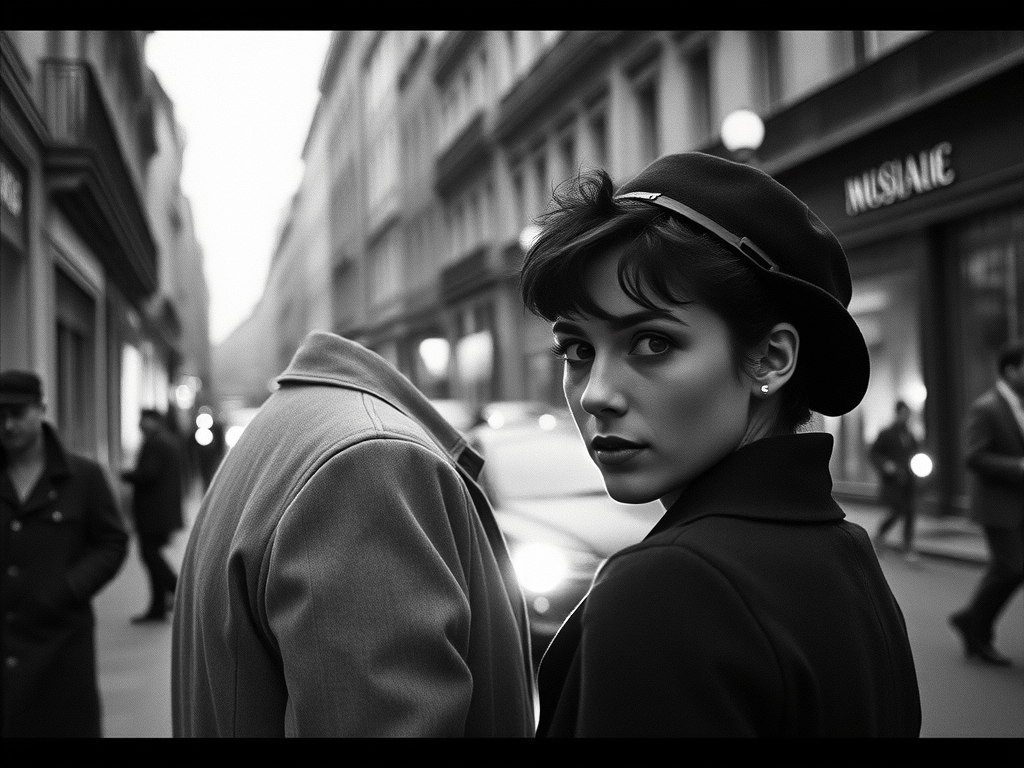
The film I’ll be discussing is the 1960’s black and white film Breathless.
For me I think this film is about anything but the thrill. I think this film is the most realistic look at how a Nihilist sees and experiences the world, and not in a zany serial killer/joker kind of way. The film represents Nietzsche ideas that there are two kinds of nihilists, active and passive. Both believing the world and life are seemingly meaningless endeavors. However, the two handle this differently, Michel seemingly charismatic and carefree fully throws himself into the moment of here and now. This is apparent in the way he behaves; he’s a criminal who kills a police officer after stealing a car and returns to Paris and pursues a girl and a loan, having not a concern in the world. It’s also apparent in the dialogue between him and Patricia, he attemptsto get her to sleep with him in almost every single conversation he has with her. For Michel, the meaningless of life is an enjoyment, an opportunity to do it once and fully. One might think he’s lost given his poor choices and hyper fixation on intercourse and fleeing to Italy, but I think Michel controls his own destiny. Even when the police are about to arrest him, he seems reserved, having time to flee and purposely making the choice to stay.
An interesting side note, the theme of fear and bravery is played with a lot with Michel’s character. He’s seen mocking Patricia for being a coward saying ‘being afraid is the worst sin there is’, but later saying he killed the police officer because he was scared. This contradiction is also put on display when he states he wants to face police at the end and ends up running from them.
Patricia on the other hand is a passive nihilist, the meaningless of life is not necessarily freeing to her, it leaves her to be both dissatisfied with the emptiness of life and terrified. For example, she states that she is unsure if she is unhappy because she isn’t free, or if she isn’t free because she’s unhappy. There is something to be said here about Patricia being an American student in Paris in the 1960’s and being an aspiring journalist. I think these are very deliberate decisions made by the writers. The 1960’s wasn’t necessarily a tame time in the United States for young people. It’s interesting that while her peers were smoking dope and dropping acid, she was trying to find ways of escape. It’s also important that she is a journalist and a student, to me this is a practical choice for those who are searching and not too sure or expectant of the answer, or even what they are looking for. Both these settings allow her to explore her own life and world but in a practical way. This is demonstrated when she interviews a famous novelist, the other journalists are asking questions regarding success and trivial things while Patricia asks questions like, ‘what is your greatest ambition in life?’ This is obviously not a question for him, but really for herself that she doesn’t know the answer to. The novelists answer of ‘to become immortal, and then die’, underscores the nihilistic overtones of the whole film.
Following the theme of nihilism, even the attention of the plot itself is meant to show the world through the lenses of a nihilist. There are several major events in this film; a car is stolen, a police officer is murdered, fugitives hidden, pregnancy, loan sharking, shootings, and more. And yet, the film doesn’t focus on that for more than maybe 15 minutes. It is always a looming presence in the background and drive the plot forward, but most of the dialogue is not about that.




 Creator1
Leave a comment