
In May of 1774, Virginia was still a colony of the British Empire. During this time, Virginia was governed in part by the house of Burgesses, this resembled a ‘lower house’ in the Virginia General Assembly, it existed from 1619 to 1776 and acted as part of the political system in the colony to balance out the power from the crown appointed governor.
The governor of Virginia at that time, was John Murray, the Earl of Dunmore. The House of Burgesses asked Governor Murray to declare war with the Indians and call out the Virginia Militia to fight.
This happened because settlers were moving into West Virginia, Kentucky, and south of the Ohio river. The conflict came when the Shawnee tribe and the Iroquois Confederacy began crossing the Ohio river to attack settlers. These lands had been traditional hunting territory for these tribes and the settlers moving there disturbed this. The native population also saw this as a larger encroachment and violation of their sovereignty.
The House of Burgesses argued that settlers were well within their legal rights to settle the area, sighting the Treat of Fort Stanwix. This treaty was signed by representatives from the Iroquois tribes and Great Britain. The British were represented by negotiators from New Jersey, Virginia, and Pennsylvania in 1768. In this treaty, Iroquois needed rights to Kentucky to Virginia, additionally, the British retained control over almost all of present day West Virginia. It aimed to settle disputes for land between the tribes and the Penn family. The British would end up paying the tribes for this land in what would be called the New Purchase, it was the highest amount Britain ever paid a Native American tribe. It’s important to note that the Shawnee were vocal opponents of this treaty and did not agree to it.
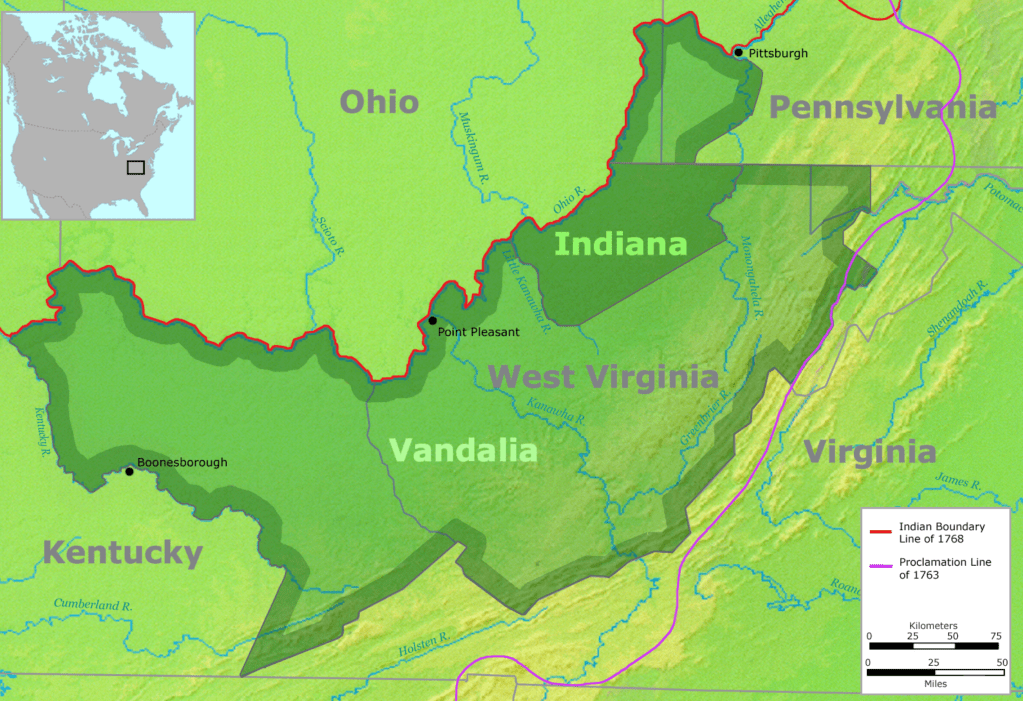
The war would be mostly battle free until October 10, 1774 At the battle of point Pleasant. Colonel Andrew Lewis was moving his troops into the Ohio valley in order to quell the indigenous population from attacking settlers. The Shawnee leader Cornstalk led a surprise attack on the militia commanded by Lewis. Lewis was to meet another force approaching from the west in order to force the Shawnee to agree to the treaty as a show of force.
Cornstalk wanted to prevent the two forces from gathering and moved roughly 300-500 warriors to Lewis’s camp. Cornstalk and his band attacked Lewis’s small army, but was outnumbered by at least 2:1. Historical accounts suggest Lewis had supplies and over 1,000 men. The fighting was brutal, eventually turning to hand to hand combat. Lewis order Captain George Mathews (who would become a brigadier general later) to move up the adjacent Kanawha river and flank Cornstalks men, the maneuver was successful.
At the end of the battle, the Virginian’s lost 75 people and over one hundred wounded. The Shawnee sustained 41 deaths and an unknown amount wounded. The Virginians took scalps, guns, tomahawks, and other plunder from the killed Indians. They would later sell what they didn’t need at auctions. The losses, and isolation from allies would make Cornstalk quickly sign a Treaty at Camp Charlotte. Cornstalk would agree to discontinue hunting in the region and stop killing and harassing settlers traveling on the Ohio River. The Mingos, who were allied with the Shawnee, refused this treaty too and had their villages subsequently burned to the ground. Their village was called Seeking, Salt Like Town which is near present day Columbus). Between the Shawnee’s agreement to the Treaty and the Mingos slaughtering, there was little to no resistance left.




 Creator1
Leave a comment